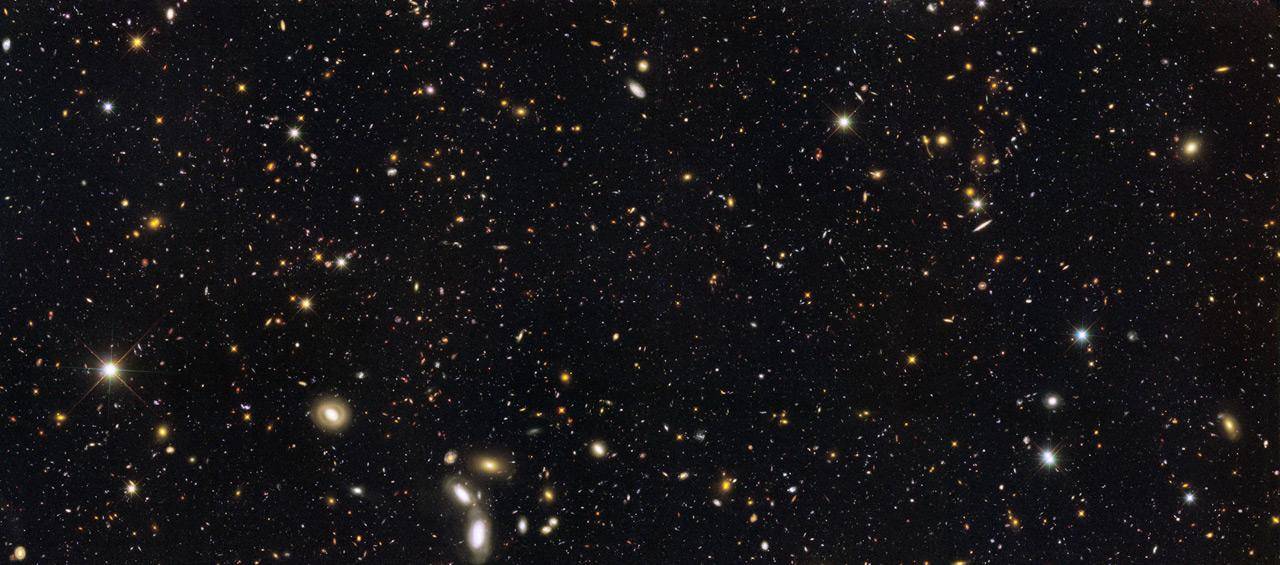
Supernova Didius, named after a Roman emperor, is the white dot in the center of this image. The bright blob at upper left is the core of the supernova's host galaxy. The supernova is so far away, we see it as it appeared 7 billion years ago.
This image reveals details of one of the most unusual nebulas known in our Milky Way. Cataloged as HD 44179, this nebula is more commonly called the "Red Rectangle" because of its unique shape and color.
This image of spiral galaxy M83 captures thousands of star clusters, hundreds of thousands of individual stars, and "ghosts" of dead stars called supernova remnants.
This image captures the collision of two galaxies. The larger spiral galaxy, NGC 6745, boasts an intact nucleus as it interacts with the smaller, passing galaxy that is nearly out of the frame to the lower right. Some Hubble images use data acquired over several days of observations.
This image of Saturn captures details in the hazes and clouds of the planet's atmosphere. The view is so sharp that it also reveals individual ringlets in Saturn's ring system.
This loose collection of stars is actually a dwarf irregular galaxy, called Holmberg IX. Of the more than 20,000 stars that can be resolved in this image, only about 10 percent are considered to be old stars.
This infrared image of the center of our Milky Way galaxy reveals a population of massive stars and complex structures in the hot ionized gas that swirls around the galactic core. Some Hubble images use data acquired over several days of observations.
This circular feature on the left side of this image is an interstellar bubble called N44F. It is being inflated by a torrent of fast-moving particles from an exceptionally hot star once buried inside this cold, dense cloud.
The bright star RS Puppis is swaddled in a cocoon of reflective dust illuminated by the glittering star. The star is 10 times more massive than our Sun and is 200 times larger.
The arms of the "grand design" spiral galaxy M81 are filled with young, bluish, hot stars. The greenish regions in the image are bright, gaseous clouds where new stars are forming.